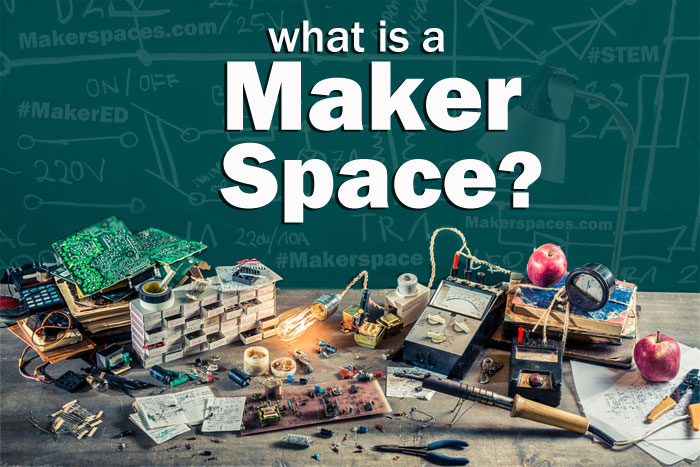
What are Makerspaces?
Makerspaces are a way to introduce a collaborative and creative learning environment for students. There is no set “thing” for makerspaces, with it only being a place for students to develop, learn and explore and can be delivered in various forms. Having students construct something with a 3D printer can be part of makerspaces, or even designing a level in bloxel are all part of a makerspace (Halverson & Sheridan, 2014; Peterson & Scharber, 2017). And are all able to provide students with a multimodal learning experience (Fischer, Hmelo-Silver, Goldman & Reimann, 2018; Dalton, 2020).
/SocialConstructionism-5c53d71f46e0fb00013a1fc0.jpg)
Makerspaces directly relates to how students learn through a constructivist perspective, creating an environment where students are able to learn through making (Dalton, 2020; Hyde, 2015; Peterson & Scharber, 2017). Students are actively engaged when working on their projects, and are also able to develop key academic, social and technical skills (Dalton, 2020; Fischer et al., 2018). Makerspaces are deeply entwined with constructionist pedagogy, focuses on the students actually creating in order for them to develop and learn (Fischer et al., 2018; Hyde, 2015).
How can we include Makerspaces into our education?
There are various ways that Makerspaces can be implementet into education, with various apps and programs available such as bloxel, 3D printing, and even games like minecraft (Halverson & Sheridan, 2014). However what is important about Makerspaces is not what students learn to use, but how and what students learn from making (Dalton, 2020; Fischer et al., 2018). Makerspaces teaches students to realise the skills involved in the process of developing, implementing, persisting and experiencing (Halverson & Sheridan, 2014; Schad & Jones, 2019). This means that the program or tools they use are secondary when compared to the ‘way’ which students are learning.

In order to successfully integrate Makerspaces into education, students learning should be focused on designing, creating and experiencing the various processes of makerspaces. Furthermore teachers also need to be prepared to facilitate this learning, instead of solely focusing on the technology, as both the teacher and the technology are there to facilitate students learning and not dictate it (Halverson & Sheridan, 2014; Fischer et al., 2018). Allowing students to benefit from the design thinking, constructionist learning and collaboration while also providing them an immersive and interactive learning experience.
References:
Dalton, B. (2020). Bringing Together Multimodal Composition and Maker Education in K–8 Classrooms. Language Arts, 97(3), 159-171.
Fischer, F., Hmelo-Silver, C., Goldman, S., & Reimann, P. (2018). International handbook of the learning sciences (1st ed.).
Halverson, E., & Sheridan, K. (2014). The Maker Movement in Education. Harvard Educational Review, 84(4), 495-504. doi: 10.17763/haer.84.4.34j1g68140382063
Hyde, B. (2015). Confusion in the Field! Providing Clarity on Constructivism and Constructionism in Religious Education. Religious Education, 110(3), 289-302. doi: 10.1080/00344087.2015.1039384
Peterson, L., & Scharber, C. (2017). Learning About Makerspaces: Professional Development with K-12 Inservice Educators. Journal Of Digital Learning In Teacher Education, 34(1), 43-52. doi: 10.1080/21532974.2017.1387833
Schad, M., & Jones, W. (2019). The Maker Movement and Education: A Systematic Review of the Literature. Journal Of Research On Technology In Education, 52(1), 65-78. doi: 10.1080/15391523.2019.1688739
 EDUC3620 - Digital Creative and Learning
Hi Jason, I appreciated the focus you placed on creating a makerspace for students in your post. When we first hear the word ‘makerspace’ it sounds like it encompasses a lot more, so I’m pleasantly surprised to hear that it doesn’t have to be that difficult! I liked the way you explained the pedagogy behind using makerspaces – it’s really clear and useful to read. I believe collaboration is a particularly large benefit in using makerspaces, in comparison to its many other benefits. Having the consistency of communication and collaboration is extremely important to foster constructionism in students, but teachers can also easily observe, guide and asses student’s learning this way.
LikeLike